Sunday, September 24, 2006

After the Walls, Now Taking Care of the Roofing

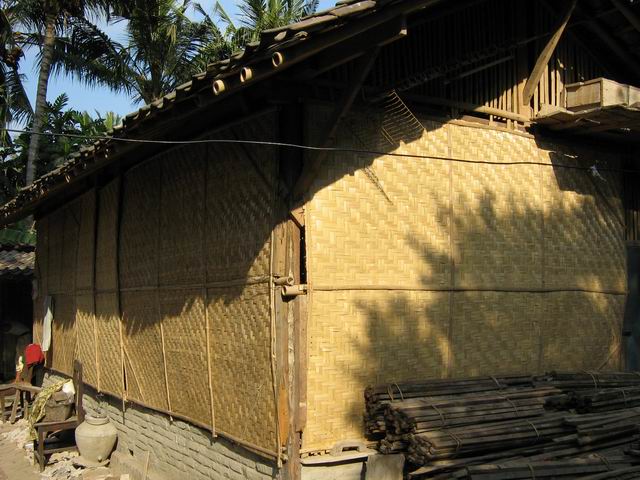
Most of the houses in Bicak and Ngunut have rebuilt their walls using "gedeg". Although these homes are much simpler than the ones destroyed by the earthquake, the conditions are now much better than immediately after the disaster.

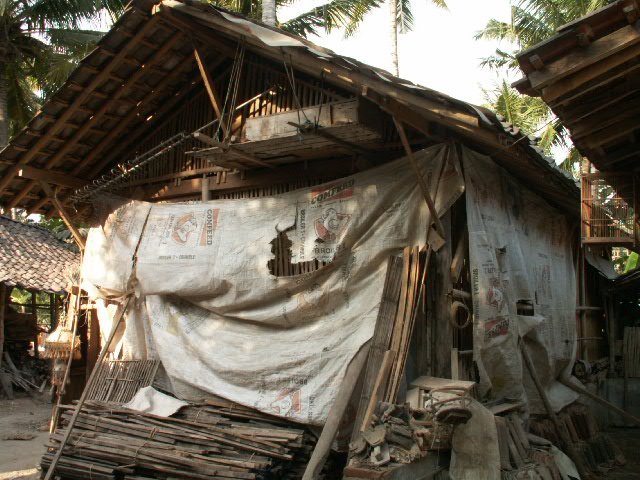
Roofing is now our main concern because the wet season begins around October. The impending monsoonal rains are a cause for concern for those still living under a tarpaulin roof. Although people are diligently collecting and cleaning any unbroken tiles they can salvage, many still have tarpaulin fastened over the roof-frame instead of the fine handmade clay tiles.

The traditional Javanese roof tiles are handmade from clay, which is then gently dried in a kiln. Over time, the tiles change from terracotta-red to a dark-slate colour. Tiles are made according to a standard pattern, which means that any cracked or broken tiles are easily replaced. Individually, these tiles are fragile pieces, but as a whole they make a durable roof shielding homes from the tropical sun and monsoonal rains; it would take a great disaster to break every single tile on a roof.

SGN has begun sourcing good quality second hand roof tiles. As expected, the market for quality building materials has gone up due to the increase in demand. The price for a pallet of 1000 tiles is around Rp500, 000.00 – Indonesian Rupiah (around $72.50 Australian Dollars), compared to Rp200, 000.00 ($29 AUD) for second-hand tiles.

The residents of Bicak and Ngunut have asked me to pass on their gratitude and thanks to you. They are very appreciative of all the help they have received. As you can see from the photos following this post, every little bit of assistance is making a material difference.

Regards
Sari

Mitro's Family Home

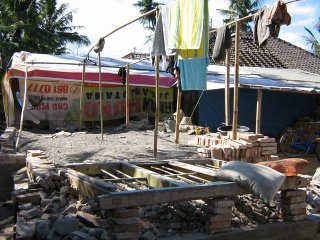
Like his neighbours, Mitro built a temporary dwelling on the site of his former home. The condition of these temporary homes depends on what could be salvaged from the old house.

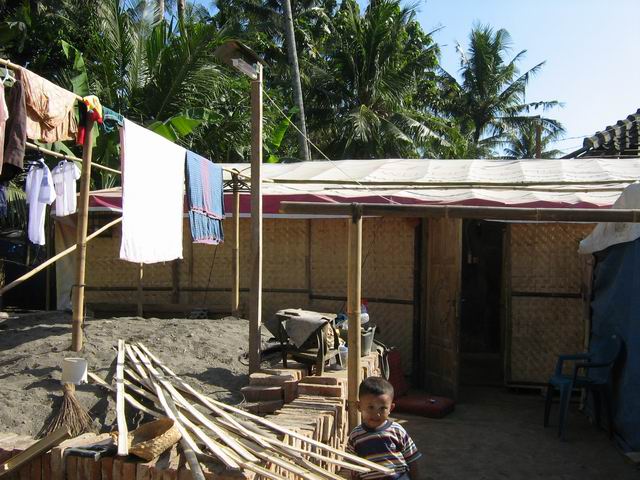
Mitro has now built a new home using the donated “gedeg” - the second photo below - this house is more durable than the temporary one built from bits and pieces.

When he has managed to collect enough materials, he plans to rebuild once again. You can see stacked neatly around his house the bricks that have been saved and cleaned from the old house.

Jumino's Family Home

Here is a photo of Jumino’s temporary home, built after the earthquake, followed by the house as it is now. The "gedeg" walls provide a more secure home.


Mangun Rejo's Family Home

The two photos below show Mangun Rejo’s home as it was and how it is now. There’s still plenty of sorting and cleaning up to do to salvage the bricks from the old house. The tiles on the roof are in good condition though, which is a good thing. The earthquake hadn't broken them all.


Paiman's Family Home

Here’s a photo of the rubble that was the Paiman family home, followed by a photo of the house as it is now. There’s a bit more privacy with the new “gedeg” walls.

It is pleasant to see the salvageable materials being saved from the rubble… things like doors, long pieces of bamboo used in the original roof-frame, other pieces of timber, the odd hardwood pillar… if not cracked, or structurally unsafe in any way, these things are put to good use. Nothing is wasted.


Ratno's Family Home

The first photo shows Ratno’s temporary house, built quickly out of salvaged materials when the family found themselves without a home.

The second photo shows the house as it is now, with its “gedeg” walls, but still missing decent roof tiles. Unfortunately most of the tiles on his old house were damaged when the house collapsed.


Reso's Family Home

Here’s a photo of Reso’s temporary home built in the aftermath of the earthquake, followed by a photo of the house as it is now.

The experiences in Bicak and Ngunut demonstrate that the process of rebuilding is one that is ongoing. People are continuously innovating, looking at ways to make improvements. They are appreciative of all the help that has been forthcoming. Outside help, plus the resilience, creativity and good humour demonstrated by these communities will put them in good stead for the future.


Slamet's Family Home

Slamet and his family built this temporary dwelling soon after they found themselves homeless.

While, immediately following the earthquake the focus was on providing emergency relief, like medicines, food, water, tarpaulins and tents. Things are progressing now and we are moving to more durable materials. People are working hard cleaning and collecting roof tiles and bricks that are undamaged and can be reused.


Slowly, things are being restored and rebuilt. The photo below, shows Slamet's house now, with the "gedeg" walls. Slamet was able to salvage many of the roof tiles from his old house. He's built his new house next to the rubble of the old one. Though there's still a lot of work to do to clean up the site.

Sunar's Family Home

Sunar’s family had worked hard for weeks cleaning up the rubble so that they could begin to build on the foundations of their former home.

In the photo below you can see the frame with the bright blue tarpaulin roof; it is a lovely contrast against the deep green of the banana leaves peaking over the back.


The photo below shows the same home, but now with the new “gedeg” walls already installed. Sunar’s family were not able to salvage much of the tiles from their former roof, most of their roof tiles were damaged when the house collapsed. They are yet to sort the unbroken bricks in the pile to the right; although most are damaged, Sunar says that some can be cleaned and reused.

Suto's Family Home

Suto and his family have been living in this temporary dwelling since the earthquake destroyed their home. When you walk around Bicak and Ngunut, it is amazing to see how resilient and ingenious human beings are in the face of adversity. Almost anything can be recycled, what was once discarded is now viewed with renewed interest, and is once again valued.


Below is the same house with new “gedeg” walls lining the outer perimeter rather than the tarpaulin and plastic sheets which rustled loudly whenever the wind blew; a mad rustling sound that is not so pleasant when one is trying to get some rest!

Tugino's Family Home

Tugino has rebuilt his family home using a combination of salvaged materials and donated “gedeg”. This house sits on the foundations of their former home. Tugino has managed to salvage most of the roof-tiles from the old house; this house is reasonably protected from the October rains. You can see that his family have also managed to salvage many of the bricks, which have been cleaned and stacked for use in the future.


The Tyas Family Home

Tyas built this temporary dwelling (picture below) on the site of his former home; a clearing around the banana trees in his garden... Can you see his ducks wandering in the foreground?
The picture below shows that Tyas has replaced much of the temporary walls of salvaged materials with "gedeg" ... though he still needs some tiles for his roof. The roof-frame for the main house is visible behind the modest "gedeg" one that he built using the donated sheets. As you can see, there is still much to be done to restore this home.

Tyas's garden or kebun is full of sensible and productive plants. Typically, women are the masters of a Javanese kebun or pekarangan… and they are characterised by biological diversity and a structure that mimics a natural forest, with huge trees serving as a canopy, and a variety of lower level shrubs, climbers and ground covers. The diversity means that there is always something to be found in the garden to supplement family meals.